
One of the most common points of confusion we see in bond applications is this:
"I'm a director, but I earn a fixed monthly salary - surely I'm employed?"
The answer is: sometimes yes, sometimes no - and it depends on the bank. In South African home-loan assessments, being a company director does not automatically make you self-employed. What matters most is your shareholding percentage in the company paying your salary - and each bank applies its own threshold.
Understanding this distinction is important, because once an applicant is classified as self-employed, the bank will require additional documentation and apply a more conservative risk assessment.
Director vs Self-Employed: How Banks Look at It
If you are a director who earns a regular, fixed salary and your shareholding is below a certain level, most banks will still treat you as salaried (employed) for credit purposes.
However, once your shareholding exceeds that bank's internal threshold, you are reclassified as self-employed, even if:
- You pay PAYE;
- You receive a monthly salary; or
- You do not draw irregular dividends.
Shareholding Thresholds by Bank
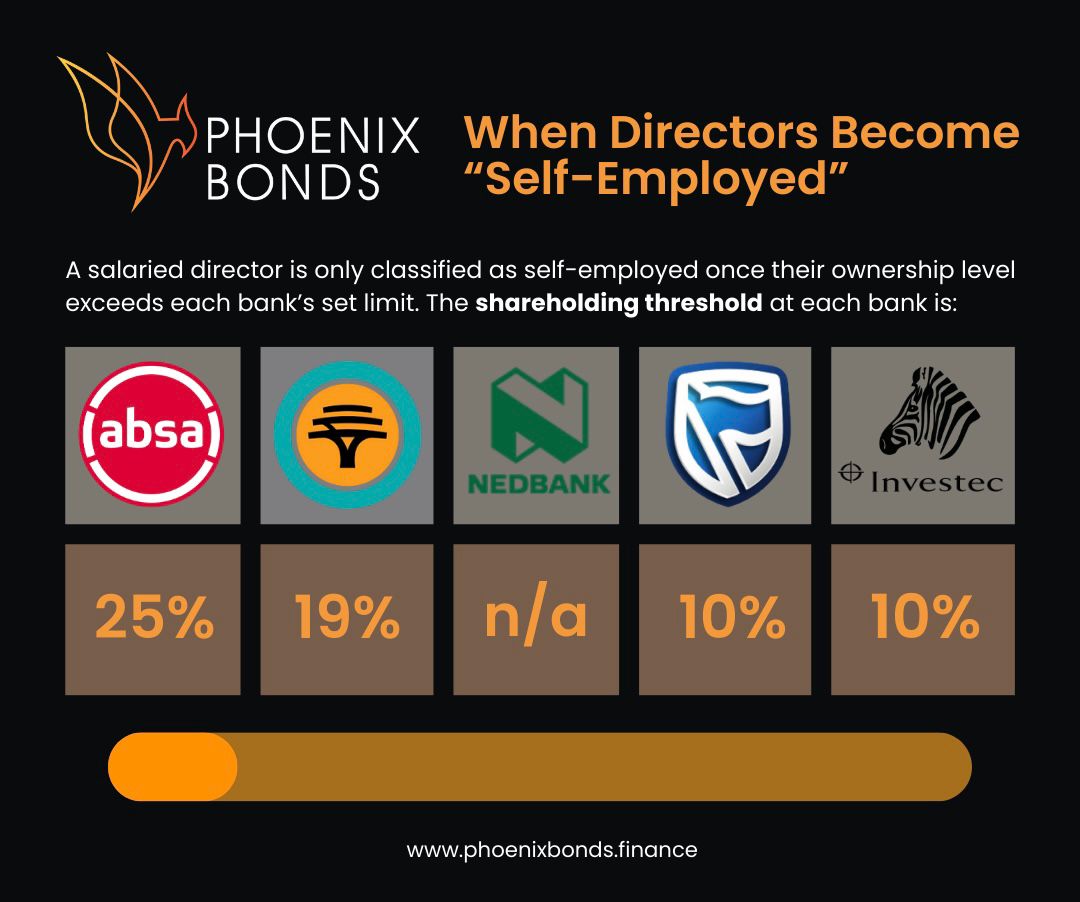
As a general guide:
- ABSA– Self-employed if shareholding exceeds 25%
- FNB – Self-employed if shareholding exceeds 19%
- Standard Bank – Self-employed if shareholding exceeds 10%
- Investec– Self-employed if shareholding exceeds 10%
- Nedbank– Applies a different approach (explained below)
These percentages are not arbitrary. They reflect each bank's view of how much control and financial risk the applicant has over the business.
Nedbank's Approach: The "Salaried Self-Employed"
Nedbank recognises a hybrid category often referred to as the "salaried self-employed" applicant.
This typically applies where:
- The applicant is a director and/or shareholder
- They receive a consistent, fixed monthly salary
- The deposits in the bank statement match the net salary on the paylsip exactly
- Income is not heavily dependent on dividends or profit drawings
In these cases, Nedbank may still require some additional documentation, but they often place more weight on salary stability rather than treating the applicant as a fully self-employed entrepreneur.
What Extra Documents Are Required If You're Classified as Self-Employed?
Once an applicant falls into the self-employed category, banks typically request additional information to assess income sustainability and business risk, such as:
- Latest 2 years of the company's annual financial statements (AFS)
- Latest management accounts for the interim period if the financial statements are more then 6 months old
- Personal and company bank statements
- Confirmation of shareholding and directorship
This is not a punishment - it's about understanding the full financial picture.
Why Banks View Self-Employed Applicants as Higher Risk
Banks base their credit models on long-term behavioural data, not opinions or assumptions.
Over time, the data shows some consistent patterns:
1. Income Stability
Salaried employees typically have:
- Predictable monthly income
- Less volatility during economic downturns
- Fewer competing financial priorities
Self-employed individuals, even successful ones, often experience:
- Variable income
- Cash-flow pressure during slower business cycles
- Periods where personal income is sacrificed for the business
2. Behaviour Under Financial Stress
Data shows that employed borrowers are statistically more likely to prioritise personal debt repayments (like home loans) during tough times.
Self-employed borrowers, by contrast, are more likely to:
- Redirect funds to keep the business operational
- Delay personal obligations to preserve staff, suppliers, or contracts
- Take calculated risks to keep the business alive
These behaviours make sense from a business perspective — but from a bank's viewpoint, they represent higher repayment risk.
3. Business Risk vs Personal Risk
For self-employed individuals, the business and personal finances are often intertwined, even when legally separate.
Banks therefore need comfort that:
- The business can survive economic pressure
- The applicant's income is sustainable
- Personal bond repayments won't be compromised to support the business
Why This Matters for Your Bond Application
Being classified as self-employed does not mean your application is weaker - but it does mean:
- More documents
- More scrutiny
- More emphasis on affordability and sustainability
This is exactly why pre-qualification and correct structuring upfront are so important.
At Phoenix Bonds, we:
- Identify which banks will treat you as salaried vs self-employed
- Package your application accordingly
- Avoid unnecessary delays or surprises once credit assessment begins
Final Thought
If you're a director earning a regular salary, don't assume all banks will see you the same way.
A 10% difference in shareholding - or choosing the wrong bank - can change:
- Your classification
- Your documentation requirements
- Your approval timeline
Getting this right from the start can make all the difference between a smooth approval and a frustrating process.